Learning How to Study
Running parallel to my interest in learning how to synthesize boatloads on info right now comes a vested interest in understanding systems of schooling. In some way it all connects back to design systems (art related).
I don’t know that I’ve ever had a tried and true method for studying. Where mystics talk about shadow work I’ve found myself at this very crossroads many times in exploring my creativity. One of the first plagues that come to mind. Overcoming beginner’s syndrome and mostly, fear.
Naturally I’m writing myself a primer. Tips, God-willing, for getting through the threads and research archive in my queue according to this thesis roadmap. Plus, my latest lab notes.
Starting with my approach in phases.
DISCOVERY
The intellectual premise of my work rests on this utopian ideal of world-building as a culturally generative design practice.
I believe it sparks a conversation about the societal benefits of the merchant class as disseminators of taste and cultural exchange, where skills also stand in for goods. Stewards of artistic tradition and indicators of political change. Consider how luxury houses are investing in material skill development. I’m getting back into the trades after what seems like forever and at first glance the trends towards craftsmanship support my thesis. Luxury is a patron of the arts.
World-building means taking an abstract cultural argument into a coherent, livable system.
RESEARCH
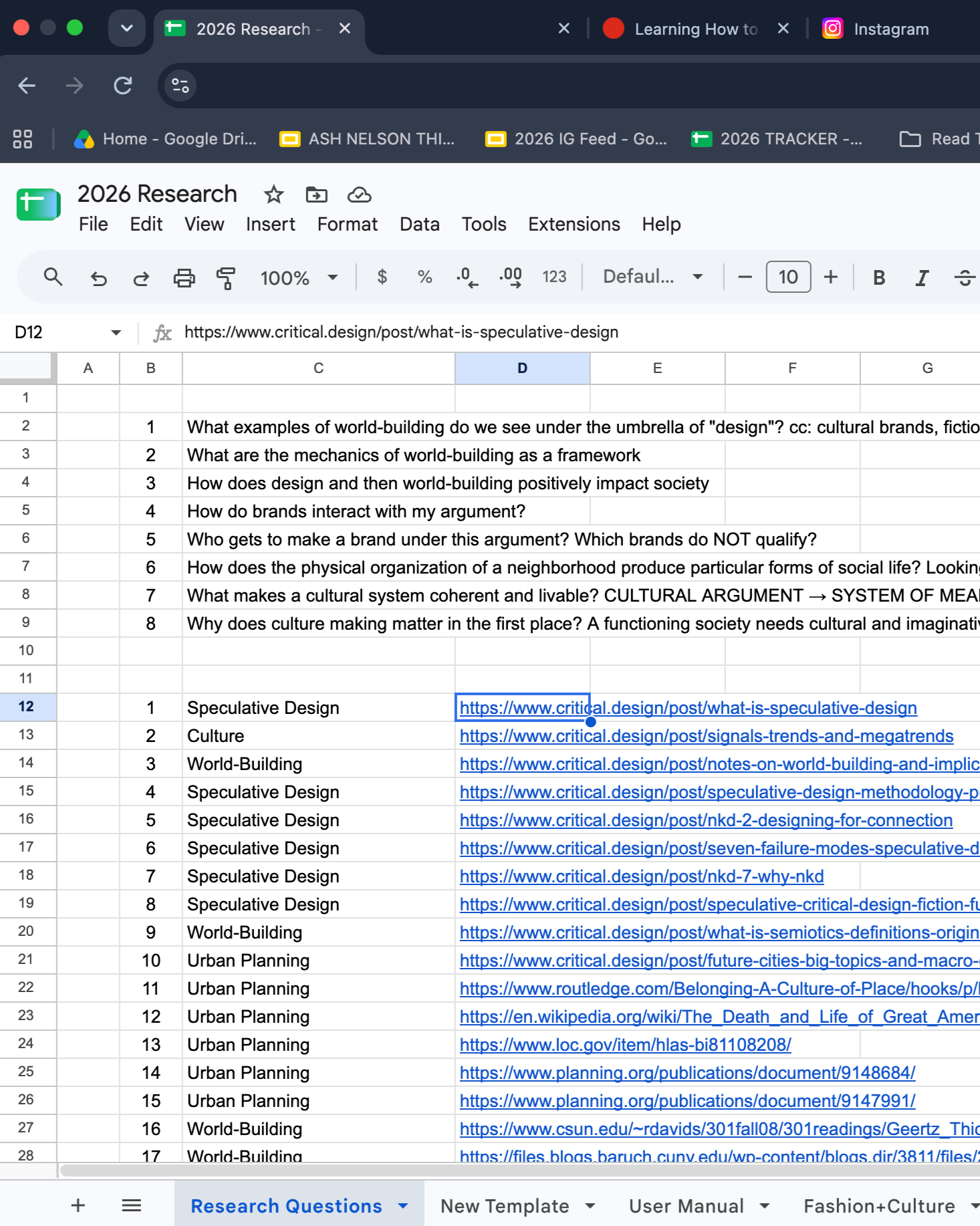
Realistically, this is what I’ve been working through. Thinking through a list of questions, grouping those into threads. I’ve decided to organize my annotated bibliography in Google Sheets - if for no other reason than I have been using spreadsheets most prominently over the course of my 10-year career.
For balance, I’ve been handwriting my lab notes and reading because I still believe in the integrity of physical media. And because I’m always so digital-first at work. In practical terms, a lot of reading and annotating. I’m growing a little stir crazy waiting for it to become something that looks like progress though.
STRUCTURE
From here the approach is a bit more hypothetical. I’ll get my bibliography to a strong enough place to prop up the bones of what I set out for. Then, back to the regimen set by The Thesis Whisperer; I also used them for my roadmap. The one modification is that I’ll write a literature review.
FORM
Pairing intellectual premise with creative form. What would happen on a fantasy island whose ecosystem is powered by “cultural generators”. How do makers and traders shape societal values? The output is my first show.
Every time I take time away from the lab I go through this mental exercise to get back to speed. This brings me to my original point: learning how to study.
///////////////////
TACTICS FOR STUDYING
How do kids learn? I’m thinking about that while doing adult research that requires me to go through large amounts of information, make connections across disciplines, follow curiosity, build a mental model, and eventually turn that into something original.
Scaffolding: Using explainers, lectures, or secondary texts to work my way up to theory I’m not ready to tackle cold.
Chunking: Stacking my research intentionally, like understanding what design is before studying how we use it to imagine future possibilities.
Questions: Starting my research with questions I’m trying to answer so I’m actually thinking across sources instead of just collecting them.
Play: Messing with ideas in real time: trying something, seeing what happens, adjusting, imagining alternatives, and trying again without there necessarily being one right outcome. Giving myself room to follow tangents, put weird ideas together, and explore connections before I know exactly how they fit into my thesis.
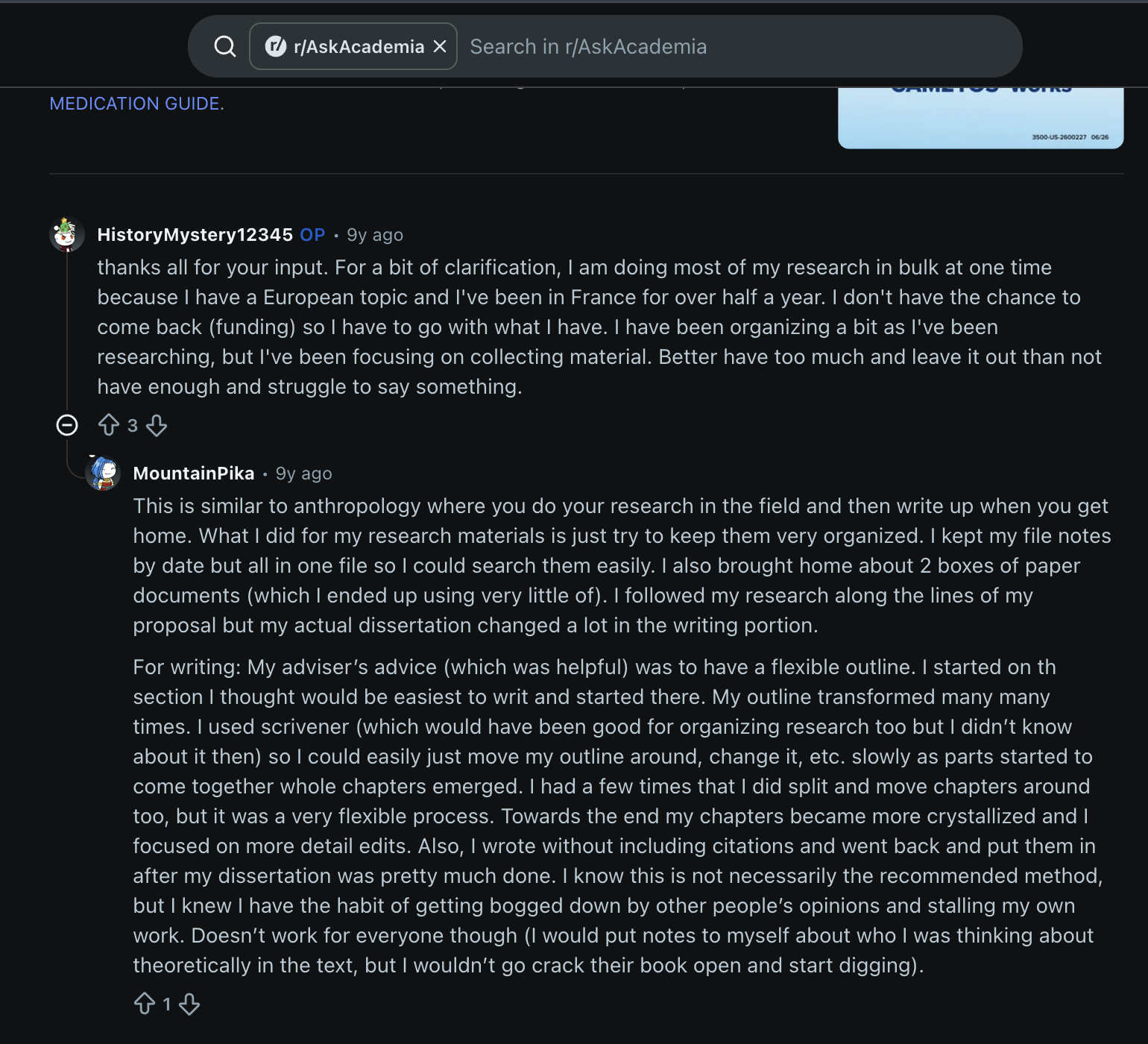
There’s also the question of tangible study tips. For that I searched Reddit for tips from academia:
Get the thoughts out and group them. They’ll start to look like something once I have more than a conglomeration of notes. Logging my annotated bibliography. Continuing to write these logs. Then, being able to group the concepts together into threads.
Write the literature review by organizing my threads into a detailed outline of building blocks (Thesis Whisperer). Compare back to the roadmap and adjust as we go.
It’s been helpful for me to lead with questions as a method of grouping.
If all else fails ask questions (100 questions):
#1: Why are we doing this?
#2: What’s the simplest explanation?
#4: What’s your most controversial opinion?
#14: Do you have a point of view?
#19: Did you write it ugly before you wrote it nice?
#23: Post review, ignore what they said - why did they say it?
#27: Is your research questioning the established authority?
#46: Are you getting the time you need? Demand it.
#61: Would a 12 year old understand it?
#90: What can you do today that you couldn’t do a year ago?
In life tips, I’m testing out a new evening to morning routine. So far I’ve gotten to a steady point. Same bed time. Same wake up. Slower mornings. Milestone.
The next tweak would be guarding the steps I’ve set for each. Treating them as more of a luxury. Beauty. Unwinding. Breath work.
Namaste.