Rick Ross knows luxury rap. He’s mastered the smooth sound and the persona to help him sell it. Rooted in Miami culture, Ross stays true to a brand culture that banks on our love for stories of crime and money. In an ironic twist, his past as a corrections officer highlights just how precise his brand strategy is.
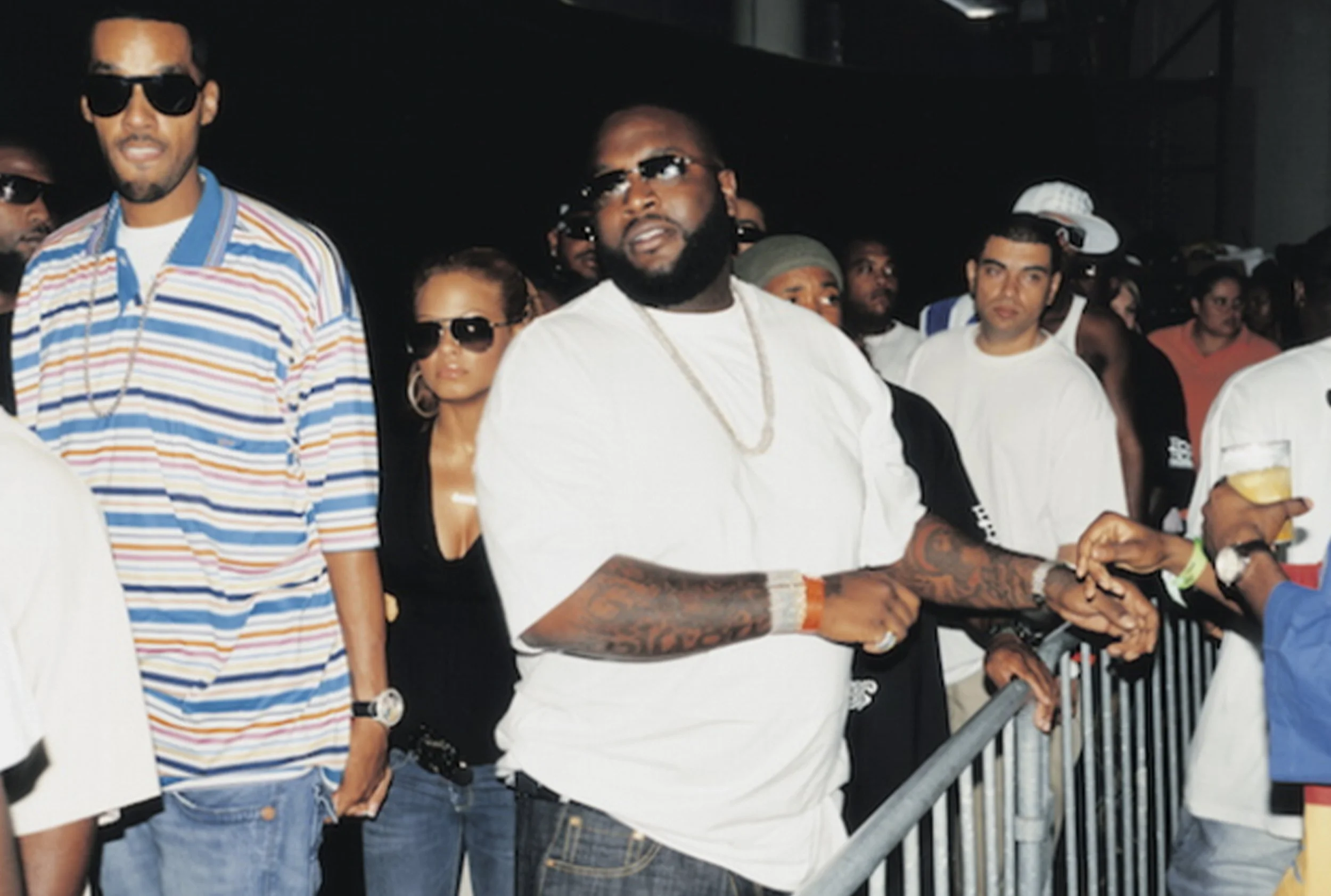
Image: The Fader, Issue 39 (2011)
Rozay’s persona is simple: a larger-than-life kingpin living in luxury paired with sounds like butter. The manifestation of him? A bit more complicated.
There’s the smooth, baritone Teflon Don emanating from our speakers and the less glamorous, William Leonard Roberts II, who fought his way there.
It starts in 2006 with his single Hustlin’. There was an uncertainty in the air about Ross in those early days. Does he have the staying power? He meets it head on with his first album, Port of Miami, which goes on to sell more than 500,000 copies.
“While the runaway success of “Hustlin’” could have positioned Ross for one-hit wonder status, he confidently sidesteps this fate by delivering the goods on Port of Miami. With a cohesive sound the city can call its own, the bearded rapper gets the release he needs by exposing the dark side of the Sunshine State.” (XXL)
His second album, Trilla was another number one. But then, in 2008, something does happen to shake up his momentum.
The news broke that Ross worked as a Florida corrections officer. Otherwise not a big deal, if not for the solid foundation of cocaine distribution he’d built his sound on. Images of this clean-shaven officer in uniform were at odds with the ominous drug-dealer on wax. Perhaps it is the very tension between the two that convince us to suspend reality and follow him into his world, fact or fiction.
As a Miami girl, I’ll admit bias here. I have teenage memories of driving past Star Island to Miami Beach, with Hustlin’ playing on the radio and the ocean sparkling at me from outside of the window. The sounds of Rozay mean something to me, especially when I’m in this city. It’s the glamour, the braggadocio, and stories from the dark side sealed to sounds that make you feel him.
Whatever the case of his actual experience, Ross knows just how to marry vibrant opulence to gritty street culture. The pairing is how he mastered luxury rap.
The Culture of Rozay
Despite it being his first, Hustlin’ is a great example of Ross’ formula for encapsulating Miami culture, a tale of two cities, both the glamour and its underbelly. It’s true that money lays the path to luxury, but there’s a price to earning it illicitly. Paired with the right production, Ross makes even that seem alluring.
“Lavish yacht cruises with silk shirts blowing in the wind, accompanied by supermodels and infinite amounts of champagne. It’s a way of life led by the most dangerous, most hated, and most successful. John Gotti, the original Teflon Don, is well-known for climbing the ranks, from a life of poverty to leading one of America’s most powerful crime families. Rozay, in a sense, carries that aura with him as best as he can. His infatuation with the mafia has remained a part of his rap identity from the start.” (HNHH)
Miami is a tropical paradise known for its beautiful people and decadent debauchery. It’s a major transportation and business hub, inclusive of its Atlantic Ocean port. Equally part of its history is the city’s ties to the drug trade, namely cocaine. At its peak in the 80s rose “Los Muchachos”, Willy Falcon and Sal Magluta, dominant Miami figures who became known for importing 75 tons of cocaine into the city during their reign (cc: Cocaine Cowboys). It’s said their drug money helped build the city as it made its way throughout the community. “If you were a grocer, a jeweler, in real estate, sold wine or had a restaurant or a nightclub, you were touched by those narco dollars.” (The Guardian)
Hip hop’s fascination with the mafia isn’t new either. When Ross signed to Def Jam it was under Jay Z, the blueprint. From the start, Jay Z spoke of his drug-dealing days around the Marcy housing projects and aspirations for wealth and its trappings. As his career developed, we saw an evolution of the rapper Jay Z into the businessman and hip hop’s first billionaire. Ross represents an extension of that blueprint for creating a path from hip hop to luxury.
Read: The Jay-Z Strategy to Influence
In 2006, when he blew up, artists like Jeezy and Ghostface Killa were also on the scene talking about the same life. There’s something about the fast life that makes for great storytelling.
The Keys to Rozay’s Luxury Rap
The signature of Rozay lies in his detailed portrayals of both luxury and crime over the backdrop of production that transports the listener into his world. Today that hallmark is best described as “Maybach Music”.
“What first started as a concept for a song would go on to become a six-part series and the name of my record label. Now it’s synonymous with everything I do. When you think Maybach, you think Ricky Rozay. The Mercedes-Benz Maybach had just beaten out Rolls Royce and Bentley as the world’s most prestigious automobile according to the Luxury Brand Status Index. I didn’t know too much about that list but I did know the Maybach was the ultimate symbol of prestige...In my imagination the Maybach became a symbol of the quality of music I wanted to make. It represented the amount of time and attention to detail it took to make something special. Music that sounded so exclusive and luxurious that someone could put it on in their hoopty and feel like they were just transported to the back of a 62S.” (Hurricanes: A Memoir)
Ross has been intentional about also including elements in his music that help the average listener relate to it. Part of that comes through with his persona. An allure that says he knows he’s king. Ultimately, it’s this persona that acts as an extension of his brand culture to cement his ties to luxury. He introduced himself through his music and then built the empire to authenticate it.
“I had my eyes on the new Maybachs that Mercedes Benz had just introduced. I couldn’t just rap about wearing Dickies. I had visions of me at the Met Gala in silk Versace fabrics. I couldn’t just rap about eating conch, mangos and Jamaican beef patties. I wanted marbleized tomahawk steaks from Del Frisco’s. (Hurricanes: A Memoir)
Ross solidified his brand culture: wealth, decadence, crime and grit and then infused it into all of his touchpoints. The irony of his past as a corrections officer reinforces the precision of his strategy. So today, when Ross talks about wealth he has the millions to back it up. Maybach Music has come to represent those ambitions of Hustlin’, the wealth and the power, with a cheeky nod to the psychology of the hustle itself.